 REVIVE YOURSELF SHOP

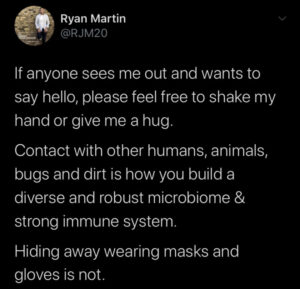
Along with eating real food, hot & cold therapy, intelligent exercise, sun exposure, fresh air, mitigating EMF’s and spending time in nature … contact with other humans, animals, bugs and dirt is essential to building a diverse and robust microbiome, as well as strong immense system.
Hiding away indoors, wearing masks, using anti-bacterial wash and wearing gloves is not.
In fact more and more research show just how much our health depends on the flourishing microbiome in our guts – and on how much of the natural world’s microbiome we let infiltrate.
Research in 2004 from Mary O’Brien, an oncologist at the Royal Marsden Hospital in London, showed that not only has dirt got a microbiome, but it may double as an antidepressant, which seems crucial in this time where suicide rates have increased due to lockdown and restrictions.
She injected lung cancer patients with a common, harmless soil bacteria, Mycobacterium vaccae, to see if it could prolong their life or provide any other benefits.
O’Brien wrote in the paper detailing of her findings, “??? ???????? ????????????? ???????? ??????? ??????? ?? ????, ??? ???? ??? ???????? ???? ???????, ????????? ???? ????????, ??? ?????? ????????? ??????????? – ?? ?????, ?? ??????? ??? ????????? ???? ?? ???????? ??????.”
A few years later, Christopher Lowry, a neuroscientist at the University of Bristol, injected M. vaccae into mice and subjected them to a series of stress tests. The ones inoculated with the bacteria showed far less stressed behaviuor than their untreated counterparts – in fact, they acted as if they were on antidepressants.
In a 2007 paper published in the journal Neuroscience, Lowry and his team wrote that the bacteria activated groups of neurons in the mouse brains responsible for producing serotonin – a neurotransmitter that, when impaired, can cause depression.
Even more intriguing was the neurons that lit up were also known to be related to immune response, suggesting an intimate connection between the immune system and emotional health.
(If you’ve been following my content for a while, you won’t be surprised at that finding.)
I developed a real passion for research on the gut and it’s impact on the immune system around 11 years ago when I was on my healing journey – and this was a time before the medical world would even give gut health the time of day. In fact the mere suggestion that the gut and its microbes could affect a persons overall health and performance, would get you laughed out of a room in medical circles.
Well, a lot of time has past since then and now the world of biomedical research seems to have fallen in love with the realm of the human gut microbiome.
And as we in the natural health world have known for some time, there is now a new body of evidence that tells us the millions of microbes in our digestive tract influence our immune systems, our smells, our mood, and possibly even our attractiveness to mosquitoes and to other people.
(This one of the reasons women should get off the pill when they think they are in love with someone, but that’s for another day.)
There’s now good evidence to draw the conclusion that breathing in, playing in, and digging in dirt may be good for your health and that our modern, sterilised life in sealed-off office buildings and homes are not.
Deep down we know this.
Not only do these buildings remove us from nature, but most are hugely toxic, with research showing, the air in your house or office is 10 to 100 times more toxic than the air outside.
Researchers have already found clear evidence that childhood exposure to outdoor microbes is linked to a more robust immune system; for example, Bavarian farm children who spent time in family animal stables and drank farm milk had drastically lower rates of asthma and allergies throughout their lives than their neighbours who did not.
However, the rest of us, not raised on farms, may be missing out on that sort of protection.
Some counterbalance, like spending time in a garden, playing sport outside, walking through the woods and being around other humans who are doing the same things, would definitely change that.
Our ancestors lived for centuries with a host of ancient parasites, fungi, and bacteria and didn’t mind at all.
It’s almost like we have forgotten that these bugs are beneficial for us .
Emeran Mayer, a gastroenterologist and neuroscientist at the University of California-Los Angeles and author of The Mind-Gut Connection says on this …
“???? (??? ????) ????? ???? ?????? ?? ??????? ?????????, ??? ????? ???? ???? ?? ????????? ???? ??. ???? ?? ????? ????????? ??????? ????????? ??????, ??? ?????? ??? ?????? ???? ?? ??????? ?? ????????? ????, ???. ??? ??????? ?? ??? ??? ???? ?? ??? ? ???? ???? ?????? ?????? ?????? ???? ????’? ?????? ??? ??? ??????.”
And that right there is the key. These bugs helped us develop a stronger, more robust immune system.
This is also what the “old friends” theory developed by University College London microbiologist Graham Rook in the early 2000s suggested, when the “hygiene hypothesis” didn’t seem to be able to explain why autoimmune conditions like allergic asthma were on the rise even in so-called “unhygienic” cities.
The hygiene hypothesis pinned skyrocketing allergic and autoimmune disease rates on just our modern obsession with cleanliness … which is certainly part of the problem.
Whereas the “old friends” hypothesis casts a wider net of blame, implicating modern medicine’s aggressive antibiotic use, pasteurised food, indoor living, and anything else that is eradicating these “old friends” from our systems.
I would say that theory, isn’t actually a theory at all. With my 11 years helping people overcome all manner of chronic illnesses and advanced disease, I can say it is a fact.
A modern lifestyle combined with modern medicines aggressive stance on killing bacteria which is linked to Louis Pasteur’s outdated and debunked germ theory – which makes them billions of pounds in selling drugs and vaccines – has lead to chronic illness, allergies and disease reaching to levels we’ve never seen before.
(In fact chronic illness was the biggest threat to our economy before this plandemic.)
If you want to understand how an ancient soil and bacteria might ward off anxiety and depression, then you need to take the “old friends” theory about modern immune dysfunction, and combine it with another biomedical concept researchers are just beginning to understand …
… and something that we in the natural health world have been taking about for decades …
… and that is that the immune system and the brain are intimately connected.
Research is showing more and more proof that depression and other mental health conditions are associated with prolonged inflammation, which is a sure sign of an immune system problem.
This is why when ever I discuss mental health, I always include a persons overall health in that equation.
Remember the brain can only be as healthy as the blood that surrounds it, and if you are chronically inflamed, that inflammation will impact your gut, and subsequently your brain.
So as you can see, there’s plenty of research to show you that hiding away at home will not only provide you no protection from pathogens and bugs, but it will actually lower your immune system, and make your more susceptible to infection.
Therefore, if any of you see me out, please feel free to shake my hand or give me a hug to say hello – you can even give me a kiss if you wish – because that one sure way we can build a strong internal environment, and you can be sure that both our immune systems will thank us for it.
Health & Happiness
Ryan
P.S. If you have been struggling with your own health issues and would like to see if or how we could help you then click the link here, fill out the form and Ryan or one of the team will be in touch as soon as possible.